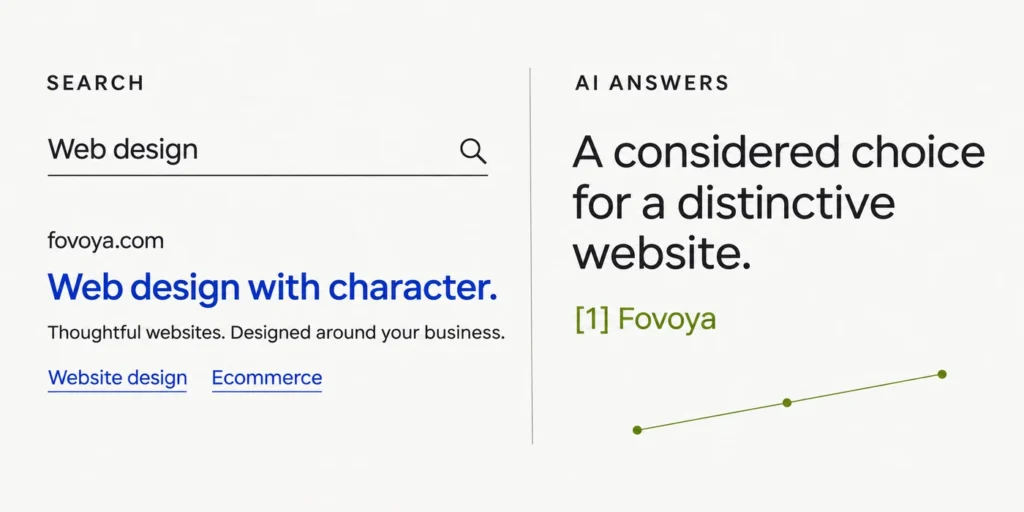
A keyword tells you what someone typed. Search intent is the task they may be trying to complete: understand a problem, compare their options or find someone who can help. Planning website content around that task makes it easier to decide what belongs on a service page, what deserves a guide and what can be answered in a short section.
At Fovoya, we use that distinction when connecting a website’s content and structure. The aim is to give each useful page a clear job and help visitors take an appropriate next step.
Start with the customer’s decision
Before collecting more keywords, write down what your customer needs to decide. A business buying a website may need to understand the scope, compare platforms, prepare content and judge whether a designer is suitable. These questions are related, but they do not all need the same answer or page format.
Google’s guidance on people-first content encourages content created for an intended audience. A useful planning question is: would this page still help a prospective customer if they arrived through a recommendation rather than a search?
Separate purchasing, comparison and learning needs
These three groups give a small business a manageable starting point:
- Purchasing: someone is looking for a provider, product or service. A useful service page explains what you offer, who it suits, the agreed scope and how to enquire.
- Comparison: someone is choosing between approaches. A guide can explain meaningful trade-offs, requirements and situations where each option makes sense.
- Information: someone needs an explanation or practical instructions. An article can answer that question directly and show where further help is available.
A query can carry more than one need. For example, a pricing question may be part of both researching a service and choosing a provider. Treat the groups as planning aids, then review the actual results in your target language and country before deciding on a format.
Use one business example to test the plan
Imagine a business making fitted shelving. The following are hypothetical queries to illustrate the method, rather than findings from a live keyword study.
“Bespoke shelving company” suggests a provider search. The main shelving service page could explain room types, materials, the measurement process, genuine project examples and what the customer should send when requesting a quote.
“Fitted or freestanding shelves” suggests a comparison. A guide could discuss installation, flexibility, awkward spaces and how the decision affects the room. It should explain when either choice is sensible, instead of forcing every reader towards the most expensive option.
“How to measure an alcove for shelves” suggests a practical question. A clear measuring guide could explain which dimensions to record and when a professional survey is still needed. A relevant link can then take a reader to the service or enquiry process.
Each page helps with a different decision. The content plan becomes useful because the answers differ, rather than because three phrases were placed in three titles.
Group related phrases before creating new pages
Do not make a new page automatically for every keyword variation. Phrases such as “bespoke shelving company”, “custom shelving service” and “made-to-measure shelving” may describe the same offer and customer task. One complete service page may be the appropriate home for that group.
Ask whether a proposed page needs a substantially different answer, audience or delivery scope. If you would repeat the same introduction, examples and enquiry form, consider improving the existing page instead. A genuinely different service or detailed practical topic can justify a separate page when you have enough useful information to explain it.
Give every planned URL a short brief
A content plan does not need a complicated scoring system. For each page, record:
- The customer question and the stage of the decision it supports.
- The related phrases it should address naturally.
- The information, photographs, examples or instructions needed to answer well.
- The next useful action, and the page or form that supports it.
For a service page, useful evidence might be an accurate deliverables list and a real explanation of the working process. For a comparison, it might be practical differences the customer can verify. Avoid filling missing evidence with invented results, unsupported prices or generic claims about being the best.
Connect pages where the next question arises
Internal links work best when the surrounding paragraph explains why a reader might follow them. A measuring guide can point to the relevant service after explaining the limits of self-measurement. A service page can link to the guide where it describes preparing an enquiry.
Use link text that describes the destination. Google’s link best practices explain descriptive anchor text and crawlable links. Linking every paragraph to a sales page adds little help; choose the points where another page genuinely answers the next question.
Review the plan as the website develops
Before launch, read each page as a customer. Can you identify the offer, understand the answer and find the next step? Check that the page title reflects its actual content and that related pages contribute different information.
After launch, customer enquiries and search data can reveal questions you missed. Update existing pages when an answer is incomplete. Add a new article when there is a distinct question worth answering. A larger article count alone does not establish that visitors are better served.
Our SEO and AI search services connect search topics with page planning and technical foundations. If your messages need shaping, explore our website content writing services, or tell us what your customers need to understand.